
We didn't build a period tracker. We built one sentence of context.
Logging periods is a solved, free problem. The real gap is accuracy: a physiological rise getting read as "I've been off lately."
Someone asked us to add period tracking.
What we shipped is not a period tracker. It is a layer of context for stress readings. That decision explains what you will and will not see in the app, so it is worth writing down.
What users ask for is a solution, not a problem
"Add period tracking" is a solution. The problem behind it has at least three readings, and their costs differ by an order of magnitude.
A. The score is wrong. Some days the reading runs high for no visible reason. B. One less app. People want to log periods where they already log everything else. C. They want insight. Cross-cycle comparison and patterns.
A is a layer of explanation and cheap. B is a recorder and moderate. C is an analytics product and expensive. Pick wrong and the three look similar in a demo but are worth very different things.
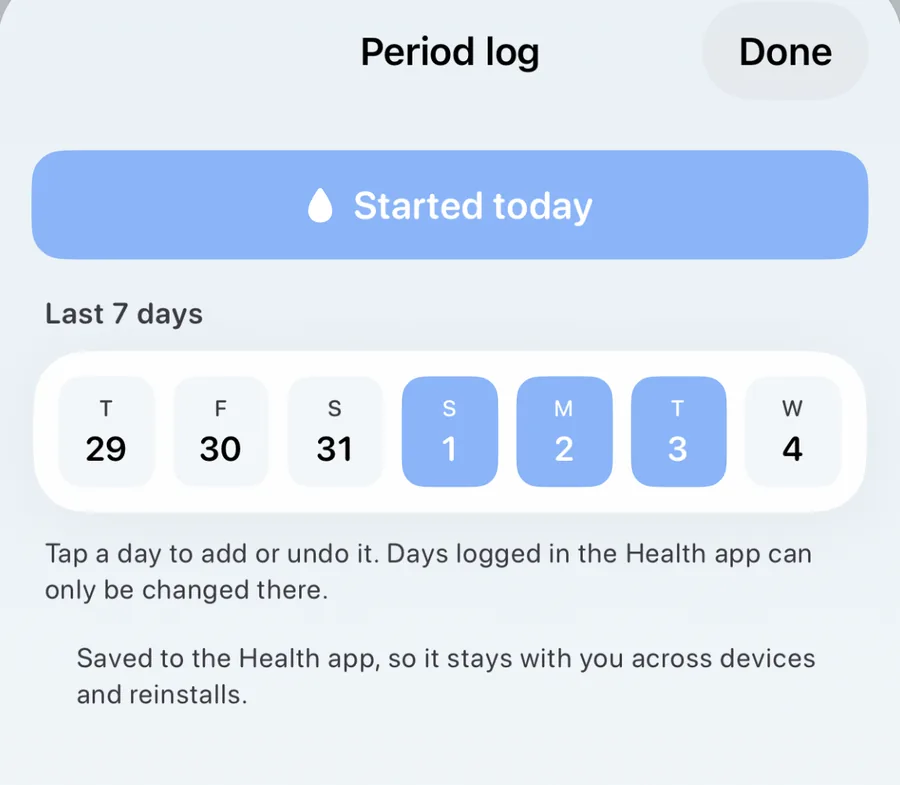
We bet on A. It is the one thing this app can genuinely contribute. Logging periods is something the Health app has done for free for years — a second implementation would not be more accurate, it would just create two records that disagree.
The gap is accuracy, not features
For people with natural cycles, one to two weeks out of every month come with systematically lower heart rate variability and a resting heart rate two to five beats higher. That is physiology, not a bad week.
Users cannot see that layer. What they see is: my stress score has been high all week. And the conclusion they draw is "I've been off lately."
That misreading has a cost. It is not just an unflattering number — it can make people genuinely doubt their own state, while we are holding data that could have said: this is where you are in your cycle, and higher readings are common here.
So the entire feature is that one sentence of explanation.
Why it does not predict ovulation
The moment a product says "you are ovulating right now," it claims predictive power. That moves it out of health management and into medical-device territory. We make a stress monitor; we should not cross that line.
It would not hold up technically either. A daily-measurement study of 21 participants found that once everyone's data was aligned to ovulation, the group-level heart rate variability rhythm was not significant — only each individual's own pattern was. There is no standard curve that fits everyone.
So this feature only does longitudinal comparison against yourself, consistent with how the rest of the app treats your baseline: your own history, not a population average.
Why sex is not used to decide who sees it
The easy approach is to read biological sex from health data and show the feature only to women.
We did not, for three reasons:
The field is sparse. Plenty of people have never filled it in, so what you read is often null. Biological sex is not gender identity. Filtering on the field locks out some people who need it and pushes it at some who do not. The cost of being wrong is asymmetric. Missing one person costs them an optional feature; wrongly including one puts a module about someone else's physiology in their settings. The second is worse.
So the feature is invisible by default: off, no popups, no onboarding, no badge. Only people who open Settings and turn it on will ever encounter it.
Why the data never enters our database
Period entries live in the Health app. We keep no copy.
That sounds like fastidiousness. It is three practical problems disappearing at once. Anything in iCloud is another surface to leak. A local copy means handling conflicts when someone edits in the Health app and we do not notice. And once the feature is off, data still sitting on our servers becomes a question with no good answer.
Using HealthKit as the single source of truth removes all three. Change phones, reinstall the app — the data is still there, because it lives in the system, not with us.
The price is slower reads and a separate permission prompt. We will pay that.
Why it only speaks for seven days a month
The first design called anything after the midpoint of the cycle "premenstrual," because the luteal phase does begin there.
Then we looked at the copy: "higher readings are common in the days before your period." These few days and half a month are not the same thing. Replacing the line from the midpoint onward would paper over a real trend conclusion for nearly half a cycle. That is not explanation, it is overwriting.
So it was narrowed to the final seven days, where the late-luteal rise actually concentrates. "These days" now means what it says.
A subtler version of the same bias sits in the median. With a single interval the median still computes, and it looks reasonable. But one interval cannot tell you whether it is your real cycle length or a one-off. So two gates were added: at least two intervals to corroborate each other, and a spread of no more than seven days across your recent intervals. A pair like [22, 34] has a median of 28 — tidy, and twelve days apart in reality.
Better to say nothing than to treat unknown as known.
Which is why you will probably never see it
If you have not enabled it, nothing in the interface changes because of it. No new entry point, no empty state, no line of explanation.
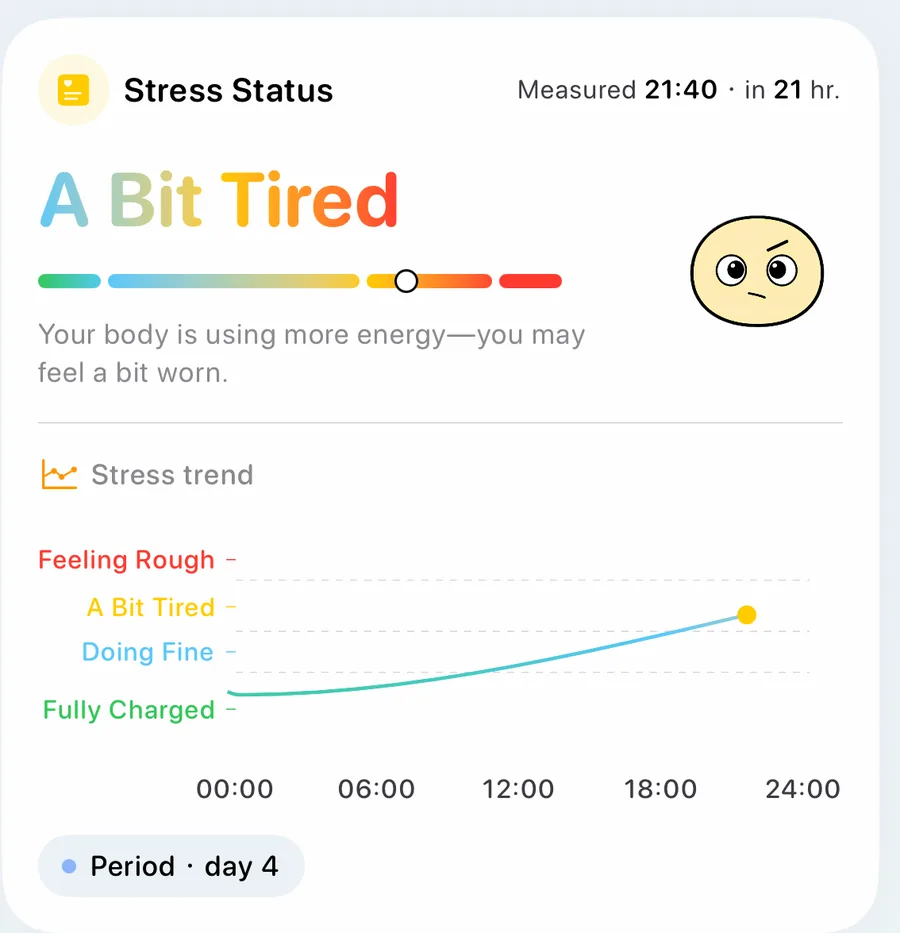
If you have, most days you still will not see it. It appears in exactly one situation: you are in the final week before your period, and today's level is medium or high. The rest of the time, the line says what it always said.
People turn it on, return to the dashboard, see nothing change, and assume it is broken. But that is the shape of the feature. It is not a module, it is a layer of context. Context shows up when it has something to add, not permanently on screen.
The right-hand text in Settings shows your current phase — proof that it is running, and the way it stays quiet.
Continuar a ler
Experimente estas ideias no Stress HRV
Descarregar na App StoreEstas notas partilham pensamento de produto sobre bem-estar. Não são aconselhamento médico.